Best Tiimo Alternatives in 2026: ADHD-Friendly Planners and Visual Tools
Tiimo won iPhone App of the Year 2025 for neurodivergent planning. The 9 best ADHD-friendly alternatives: Structured, Goblin Tools, Routinery, Habi.
Written By The Aftertone Team

Best Tiimo Alternatives in 2026
The best Tiimo alternative depends on why you're leaving: Structured for a visual timeline at a lower price with Android support, Goblin Tools for free AI task breakdown, Routinery for step-by-step routine guidance, Habi for habit tracking with focus tools, and Brite for a cross-platform visual planner with a free tier that undercuts Tiimo's price significantly.
Tiimo won the iPhone App of the Year in 2025 by doing something most productivity apps won't: designing specifically for neurodivergent users rather than treating them as an afterthought. ADHD, autism spectrum, dyslexia, and similar profiles create planning challenges that standard to-do lists and calendar grids make worse rather than better. Tiimo's visual icons, colour-coded blocks, countdown timers, and compassionate tone address those challenges directly. The Co-Planner AI feature adds adaptive scheduling assistance tuned to individual needs.
People look for Tiimo alternatives for specific reasons — price (Tiimo is $54/year on iOS or $42/year on web — $12.99/month monthly — among the more expensive daily planners), platform (iOS and web only, no Android), or because they need different capabilities: AI task breakdown, habit tracking, cross-platform access, or team/family features. This guide covers the best alternatives by the specific gap you're trying to close. Dr Russell Barkley, the leading ADHD researcher, defines ADHD fundamentally as a disorder of time blindness — the inability to sense time passing — which explains precisely why visual timeline planners help where standard to-do lists don't. This connects directly to prospective memory research: the cognitive system responsible for remembering to do things at future times is specifically impaired in ADHD, making external visual scaffolding not a preference but a functional necessity. Research in the ADHD literature suggests adults with ADHD lose an average of 22–27 days of productive work per year to executive function challenges. The tools that close that gap are the ones that make time visible and externalise the planning process.
Why people look for Tiimo alternatives
Price: At $54/year on iOS ($12/month monthly), Tiimo is one of the most expensive daily planners. Several alternatives offer comparable features at lower cost or free.
No Android: Tiimo is iOS and web only — no native Android app.
Task paralysis support: Tiimo helps you schedule tasks but doesn't break overwhelming tasks into steps — Goblin Tools addresses this gap specifically.
Habit tracking: Tiimo doesn't include habit tracking beyond routines — Habi and TickTick add this layer.
Calendar integration: Tiimo's calendar sync is limited compared to dedicated calendar apps like Morgen.
Longitudinal pattern analysis: Tiimo makes today manageable but doesn't surface what patterns across weeks reveal about which scheduling conditions support your capacity. Attention residue research shows that patterns across sessions — not just individual sessions — determine whether a scheduling system is actually working.
Quick-pick by ADHD challenge
Time blindness / need to see the day visually: Structured (free, Apple) or Tiimo itself
Task paralysis / can't start or break tasks into steps: Goblin Tools (free, web)
Routine building / step-by-step guidance: Routinery (free / $7.99/year)
Habit tracking + focus: Habi (free, iOS)
Overwhelmed by planning / want AI to build the schedule: Motion ($19/month)
Multi-calendar + ADHD-friendly visual planning: Morgen ($15/month)
Fast task capture, cross-platform: Todoist (free / $4/month)
Mac user wanting scheduling pattern analysis: Aftertone ($30/month)
Cross-platform visual planner with habit tracking, cheaper than Tiimo: Brite (free / less than Tiimo)
At a glance: all alternatives compared
App | Price | Visual timeline | ADHD-designed | Android | Primary strength |
|---|---|---|---|---|---|
Tiimo | $42/yr (web) / $54/yr (iOS) / $12.99/mo | Yes (icons + blocks) | Yes (core) | No | Neurodivergent visual daily planning |
Structured | Free / $9.99/yr or $49.99 lifetime | Yes (blocks) | ADHD-friendly | Yes | Visual timeline, lower price |
Goblin Tools | Free | No | Yes (task breakdown) | Yes | AI task breakdown for overwhelm |
Routinery | Free / $7.99/yr | Yes (steps) | Yes | Yes | Step-by-step routine guidance |
Habi | Free | No | Yes | Yes | Habits + focus timer, free |
Brite | Free / less than Tiimo | Yes (colour blocks) | ADHD-friendly | Yes | Cross-platform visual planner, habit + mood tracking |
Morgen | $15/mo (annual) | Time blocks | ADHD-friendly | Yes | Multi-calendar AI planning |
Todoist | Free / $4/mo | No | No (but fast capture) | Yes | Fast cross-platform capture |
Motion | $19/mo (annual) | No | No | Yes | AI builds schedule automatically |
Aftertone | $30/mo | Calendar + tasks | No | No (Mac only) | Calendar pattern analysis + Focus Screen |
1. Structured — best visual timeline alternative at a lower price
Best for: Tiimo users who want a comparable visual block timeline at significantly lower cost, including an Android version and a lifetime purchase option.
Structured shares Tiimo's visual block approach to daily planning but at a different price point and with broader platform support. Where Tiimo is designed with neurodivergent users specifically in mind — compassionate, adaptive, icon-based — Structured is designed for visual thinkers broadly. The block timeline, duration visualisation, and gap identification are comparable in approach. Structured also won iPhone App of the Year 2025 alongside Tiimo — both apps were awarded, which signals the strength of the visual timeline category. The ADHD community has adopted Structured enthusiastically for the same time blindness reasons as Tiimo.
The key differences: Structured has an Android version (Tiimo doesn't). Structured's Pro plan is $29.99/year or $64.99 lifetime — significantly cheaper than Tiimo's $54/year. Structured has less of Tiimo's compassionate neurodivergent-specific design language.
Pros:
Visual block timeline comparable to Tiimo — makes time concrete and visible
Available on Android, Mac, iPhone, iPad, Apple Watch — broader platform coverage
Significantly cheaper: $29.99/year vs Tiimo's $54/year on iOS
Lifetime purchase option at $64.99
Free tier is genuinely functional
Cons:
Less ADHD-specific design language than Tiimo — no compassionate tone, fewer icons
No Co-Planner AI equivalent
No mood tracking or energy check-ins
Pricing: Free tier. Pro $29.99/year or $64.99 lifetime.
Platforms: iPhone, iPad, Android, Mac, Apple Watch.
2. Goblin Tools — best for AI task breakdown to overcome paralysis
Best for: Tiimo users whose primary challenge is task paralysis — staring at an overwhelming task with no idea where to start — rather than visual timeline planning.
Goblin Tools is free, web-based, and does one thing extremely well: it takes an overwhelming task and uses AI to break it into concrete, specific, time-estimated steps. The "Magic To-Do" feature converts vague tasks like "prepare client presentation" into a numbered list of small, specific, actionable steps. The spiciness dial controls how granularly it breaks things down — more granular for higher executive function challenges.
Goblin Tools doesn't have a visual timeline. It doesn't schedule your day. But for the specific moment when a Tiimo user can't figure out how to start a task, Goblin Tools addresses that moment directly — free, with no setup. Many neurodivergent users run Goblin Tools and Tiimo together: Goblin Tools breaks the task into steps, Tiimo schedules those steps.
Pros:
Completely free — no subscription or account required
AI task breakdown specifically designed for ADHD and executive function challenges
Adjustable granularity dial — more detail for harder tasks
Works in any browser — no app install required
Cons:
No visual timeline or calendar — purely a task breakdown tool
Requires internet connection for AI features
Not a daily planner — works best alongside a scheduling tool like Tiimo or Structured
Pricing: Free.
Platforms: Web (any browser), iOS, Android apps also available.
3. Routinery — best for step-by-step routine guidance
Best for: Tiimo users who need explicit step-by-step prompting through routines — morning routine, bedtime routine, work startup — not just a visual block but an active guide through each step.
Routinery turns routines into guided sequences: you build a routine (morning, evening, work startup) and the app guides you through each step with a timer, telling you what's next so you don't have to remember. The visual progress through the routine reduces the executive function overhead of deciding what comes after what. For neurodivergent users whose biggest challenge is transitioning between tasks within a routine, Routinery provides the external prompting structure that keeps momentum going.
At $7.99/year (or free for basic), it's among the most affordable apps on this list while providing genuine executive function support that Tiimo's broader planning approach complements but doesn't replace.
Pros:
Step-by-step routine guidance — active prompting, not just a visual block
Timer for each step — addresses time blindness within the routine
Available on iOS and Android
$7.99/year — among the most affordable apps in the category
Cons:
Focused on routines only — not a full daily planner like Tiimo
No AI task breakdown or calendar integration
Works best as a complement to a daily planner, not a replacement
Pricing: Free tier. Pro $7.99/year.
Platforms: iPhone, Android.
4. Habi — best free habit tracking and focus app for ADHD
Best for: Tiimo users who want habit tracking and focus timers with screen time blocking — at zero cost.
Habi combines habit tracking, a focus timer with screen time blocking, and a simple task list in a free iOS app built by a founder with ADHD. The focus timer blocks distracting apps during work sessions — the execution layer that visual planners like Tiimo leave open. The habit tracking adds the consistency-over-time measurement that Tiimo's daily planner doesn't provide. For Tiimo users whose gap is "I plan the day but then still get distracted during execution," Habi addresses that execution layer specifically.
Pros:
Free — completely free for core features
Focus timer with app blocking — addresses execution distraction that Tiimo doesn't
Habit tracking alongside task management
Built by a founder with ADHD — genuine neurodivergent-first design
Cons:
iOS only — no Android
No visual timeline planning like Tiimo
Smaller app with smaller support community than Tiimo
Pricing: Free. Pro tier available.
Platforms: iPhone, iPad.
5. Brite — best cross-platform visual planner at a lower price than Tiimo
Best for: Tiimo users who switched to Android, hit the price wall, or need habit and mood tracking alongside a visual day plan — available on iOS, Android, Mac, Windows, and web.
Brite is a cross-platform daily planner that specifically positions itself as a Tiimo alternative. It offers a visual timeline with colour-coded blocks, a habit tracker for routines (medication, sleep, exercise), a built-in Pomodoro focus timer, mood diary, and Google Calendar sync — across iOS, Android, Mac, Windows, and web. Where Tiimo uses pictogram-based visual schedules, Brite uses colour-coded time blocks: a different visual style serving the same purpose — making time visible and concrete for ADHD brains.
The pricing is the clearest differentiator. Brite has a permanent free plan and a Premium tier that costs significantly less per month than Tiimo's $12.99/month. For users who found Tiimo's $54/year iOS pricing hard to justify, Brite covers the core visual planning use case at a fraction of the cost.
Pros:
Full cross-platform: iOS, Android, Mac, Windows, web — closes Tiimo's biggest gap
Habit and mood tracking built in — Tiimo includes neither
Free plan covers core daily planning; Premium costs less than Tiimo
Google Calendar sync
Pomodoro focus timer with ambient sounds
Cons:
No pictogram-based icons — if Tiimo's visual symbol language specifically helps your brain, Brite's colour blocks are a different approach
Less ADHD-specific clinical design than Tiimo — not co-designed with clinical specialists
Pricing: Free plan. Premium less than Tiimo's $12.99/month. Platforms: iOS, Android, Mac, Windows, web.
6. Morgen — best for ADHD users who need multi-calendar visual planning
Best for: Tiimo users who also manage multiple calendar accounts and want ADHD-friendly visual time blocking with AI planning suggestions across all of them.
Morgen is an ADHD-friendly calendar app with a Frames system — templates for recurring time blocks that visualise your ideal daily schedule (Deep Work 8–11am, Admin 2–3pm, etc.) — and an AI Planner that suggests tasks into those frames and waits for your approval. The visual time-blocking addresses the same time blindness that Tiimo targets, but at the calendar level rather than the daily routine level. Morgen handles Google Calendar, Outlook, and iCloud simultaneously — the multi-calendar coverage Tiimo doesn't have. At $15/month annually. All platforms.
Pros:
Multi-calendar support — Google, Outlook, iCloud in one view
Frames system creates visual structure for recurring time blocks
AI Planner suggests (not imposes) — respects ADHD users' need for autonomy
Available on all platforms — Mac, Windows, Linux, iOS, Android, web
Energy-aware schedule adjustment — can rearrange when energy crashes
Cons:
No free tier — 14-day trial only
$15/month — significantly more expensive than Tiimo
Less ADHD-specific design than Tiimo — no icons, no compassionate tone
Pricing: $15/month annual. 14-day free trial.
Platforms: Mac, Windows, Linux, iOS, Android, web.
7. Todoist — best for fast cross-platform task capture
Best for: Tiimo users whose primary ADHD challenge is task capture — getting things out of the brain before they're forgotten — rather than visual day structure.
Todoist is specifically cited in ADHD app guides for its natural language input speed. Type "call dentist tomorrow 3pm" and it creates the task, sets the time, and assigns the due date in under three seconds. For ADHD users who know that if capture has any friction, the thought disappears, Todoist's speed is the killer feature. The free tier covers most individual needs. Pro at $4/month adds reminders and filters. Available on every platform.
Pros:
Fastest natural language task capture available — sub-3-second from thought to task
Available on every platform — iPhone, Android, Mac, Windows, web, Apple Watch
Free tier covers unlimited tasks and 5 projects
Voice capture for ADHD users who think in spoken streams
Cons:
No visual timeline — a task list, not a day visualiser
Not ADHD-specific — no compassionate design or neurodivergent accommodations
No time blocking or calendar integration in the free tier
Pricing: Free. Pro $4/month annual.
Platforms: All platforms.
8. Motion — best for ADHD users who want AI to remove scheduling decisions
Best for: Tiimo users for whom the "when should I do this?" question is paralyzing — and who want AI to make that decision automatically rather than managing it manually.
Motion removes the scheduling decision entirely: add tasks with deadlines, and Motion places them in your calendar automatically, building the day's structure without you having to decide. For ADHD users who find the planning step itself overwhelming, this removes a significant cognitive burden. The trade-off: Motion's AI makes scheduling decisions you may not always endorse, and the sense of agency over the day's structure — which Tiimo intentionally preserves — is reduced.
Pros:
Eliminates "when should I do this?" decision — the AI builds the schedule
Reschedules automatically when priorities change or meetings appear
Available on all platforms
Cons:
$19/month — significantly more expensive than Tiimo
AI makes decisions you may not endorse — reduced sense of schedule ownership
No ADHD-specific design, no visual block timeline
Pricing: $19/month individual (annual).
Platforms: Mac, Windows, iOS, Android.
9. Aftertone — best for scheduling pattern analysis on Mac
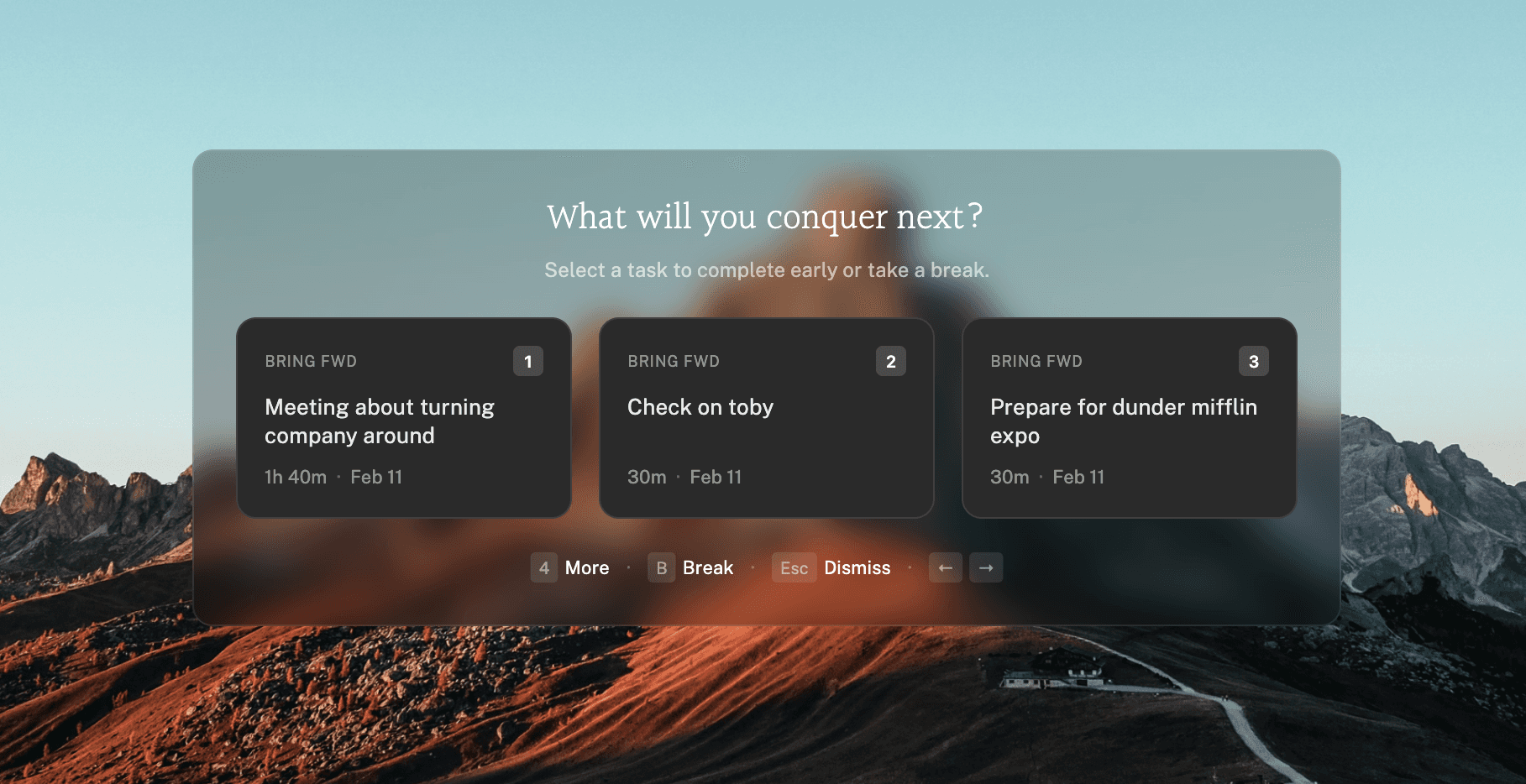
Best for: Mac-using Tiimo users who want to understand which calendar conditions — meeting loads, week structures — support or undermine their daily capacity over time.
Aftertone addresses the gap that Tiimo and all daily planners leave: what the pattern of days, across weeks and months, reveals about which scheduling conditions support your capacity. The AI weekly and daily reports read your calendar history and surface which week structures produce your most focused days, whether your meeting load is trending in a direction that will make Tiimo's daily planning harder or easier, and how your current week compares to your historically productive periods.
For neurodivergent users specifically, the external scheduling conditions — meeting fragmentation, calendar density, context-switching overhead — affect executive function in ways that are measurable from calendar history. Aftertone surfaces those patterns. The Focus Screen removes all competing tasks from view during work sessions, which addresses the visual distraction problem from the execution side.
Pros:
AI weekly and daily reports on scheduling patterns — the longitudinal layer Tiimo lacks
Focus Screen for single-task execution — reduces visual distraction during sessions
Native Mac calendar and task management
Cons:
Mac only — no iOS, Android, or Windows
$30/month — the most expensive option on this list
No ADHD-specific visual design or compassionate tone
Pricing: $30/month. 7-day free trial, no card required.
Who Tiimo is actually right for
Tiimo is right for neurodivergent users who've found standard productivity apps — with their text-heavy interfaces, rigid structures, and performance-oriented framing — create more anxiety than clarity. The App of the Year recognition confirms that the visual, compassionate, ADHD-specific design approach resonates broadly. For users with ADHD, autism spectrum profiles, or similar executive function challenges, Tiimo's visual icons, countdown timers, adaptive Co-Planner AI, and compassionate tone address problems that other apps don't acknowledge exist.
The honest ceiling: Tiimo makes each day navigable. The pattern of those days — whether your external calendar structure is supporting or undermining your capacity week over week — is a different question that requires reading your calendar history in aggregate.
Frequently asked questions
What is the best Tiimo alternative in 2026?
It depends on what you need. For the closest visual timeline equivalent at a lower price, Structured ($29.99/year, also on Android). For AI task breakdown to overcome paralysis, Goblin Tools (free). For step-by-step routine guidance, Routinery ($7.99/year). For habit tracking and focus execution, Habi (free). For multi-calendar visual planning, Morgen ($15/month). For fast cross-platform capture, Todoist (free / $4/month). For Mac users who want scheduling pattern analysis, Aftertone ($30/month).
Is there a free Tiimo alternative?
Yes — several. Goblin Tools is completely free with no account required. Habi is free for core features. Structured has a generous free tier for visual daily planning. Todoist's free tier covers unlimited tasks and 5 projects. Routinery has a free basic tier. None replicates Tiimo's complete feature set for free, but each covers a core part of what brings users to Tiimo.
Does Tiimo have an Android app?
No — Tiimo is iOS and web only as of 2026, with no native Android app. For neurodivergent users on Android who want visual timeline planning, Structured is the strongest alternative with full Android support. Routinery and Todoist also have Android apps.
What is the difference between Tiimo and Structured?
Both use visual block timelines to make time visible and concrete — the core feature neurodivergent users find most valuable for time blindness. The key differences: Tiimo was co-designed with ADHD and autism experts from the ground up — the compassionate tone, icon language, and Co-Planner AI reflect that. Structured is designed for visual thinkers broadly, not neurodivergent users specifically. Structured costs less ($29.99/year vs $54/year on iOS), has an Android app, and offers a lifetime purchase option. Tiimo has better ADHD-specific accommodations; Structured has better platform coverage and lower price.
What is Goblin Tools and why is it useful for ADHD?
Goblin Tools is a free AI tool that takes an overwhelming task and breaks it into concrete, specific, time-estimated steps. The "Magic To-Do" feature addresses task paralysis — the moment when an ADHD brain stares at "prepare quarterly report" and can't identify the first action. Goblin Tools outputs a numbered list of small, specific steps with time estimates. The granularity dial controls how detailed the breakdown is. It's free, requires no account, and works in any browser. Many neurodivergent users use it alongside Tiimo or Structured: Goblin Tools breaks tasks into steps, the visual planner schedules those steps.
Is Tiimo worth it?
Tiimo is worth it for iOS users with ADHD who need a planner built specifically for neurodivergent brains — the pictogram-based visual design, guilt-free missed task handling, and Co-Planner AI reflect genuine clinical co-design that general-purpose planners don't match. At $54/year on iOS (or $42/year on web), the investment is justified if that specific design philosophy is what works for your brain. It's not worth it if you primarily need cross-platform access (no Android native app), habit tracking (Tiimo doesn't include this), or a lower price point. In those cases, Structured ($9.99/year, Android + Apple) or Brite (free plan, all platforms) cover the visual planning core at a fraction of the cost.