The Ivy Lee Method: A 100-Year-Old Productivity System That Still Works
Written By Aftertone Team
5 min read

Plain Language Summary: The Ivy Lee Method is a daily planning system built on a single rule: each evening, write down the six most important tasks for tomorrow in order of genuine priority, then work through them sequentially the next day, completing each before starting the next, with anything unfinished carrying to the following day's list. The method's power is in what it forces rather than what it allows: a limit of six tasks makes the prioritisation decision explicit in a way that an unlimited list never does. Sequential focus addresses the attention residue problem directly by preventing task-switching during execution. The evening selection removes decision-making from the morning, when it would compete with the cognitive resources needed for the work itself.
The Ivy Lee Method: A 100-Year-Old Productivity System That Still Works
In 1918, Charles Schwab was one of the most successful businessmen in the United States. As president of Bethlehem Steel, he was running one of the largest companies in the country and, by most measures, running it well. What he wanted from Ivy Lee, a well-regarded public relations consultant he had invited to meet him, was not a management overhaul or a new organisational structure. He wanted to know if Lee could help his executives get more done.
Lee said he could, and asked for fifteen minutes with each of them. Schwab agreed. At the end of the session, Lee told Schwab to try what he had shared with the team for three months and then pay whatever he thought it was worth. Three months later, Schwab sent a cheque for $25,000, the equivalent of roughly $400,000 today. The advice Lee had given each executive took about three minutes to explain.
The method
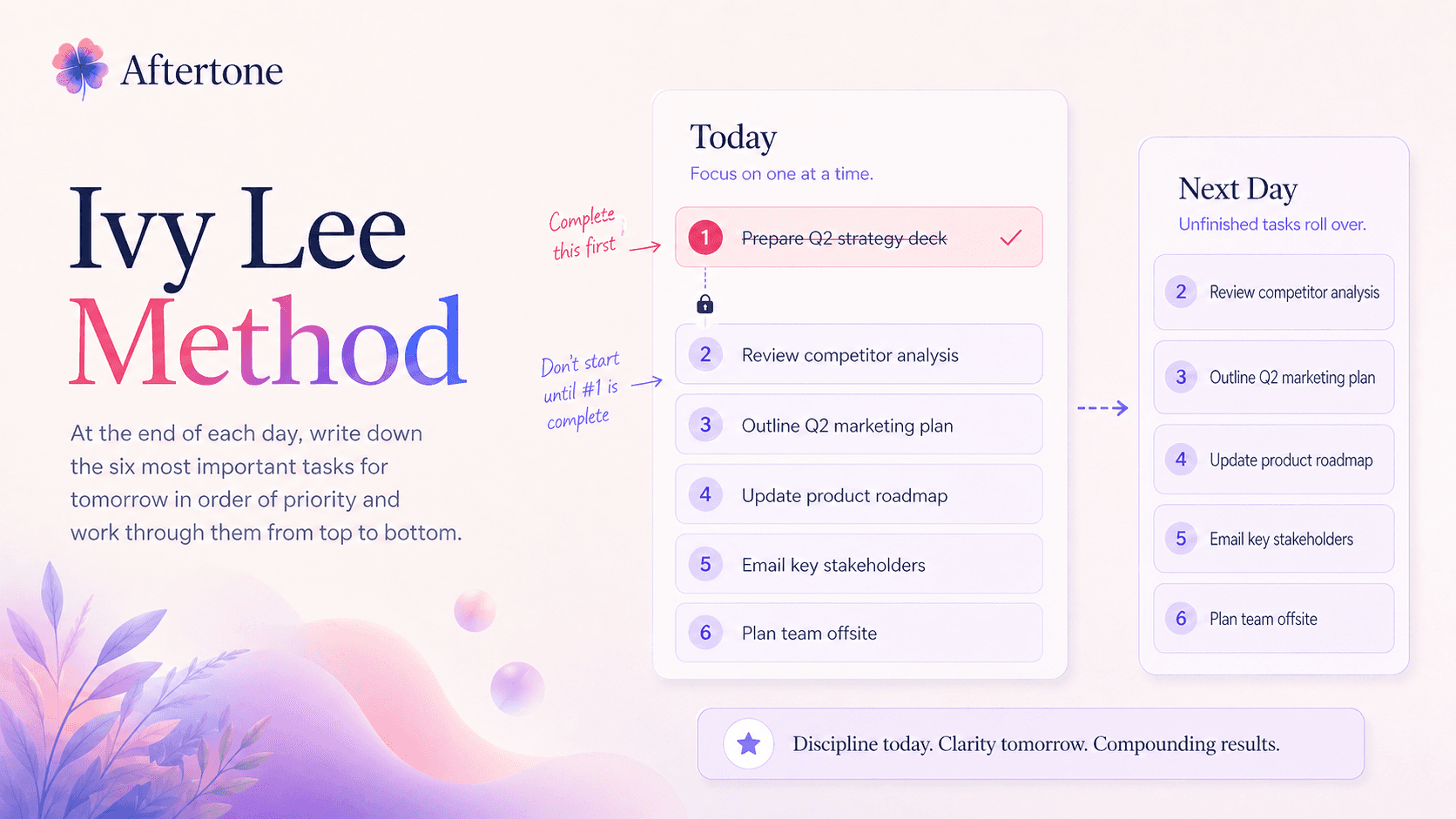
At the end of each working day, write down the six most important tasks you need to accomplish tomorrow. Not a general list of what is going on with your projects. Not a brain dump of everything you have not yet done. Six specific tasks, in order of genuine priority, with the most important at the top.
The next morning, begin with the first task. Work on it until it is complete before moving to the second. Work through the list in order. At the end of the day, any tasks not completed move to the top of the following day's list of six. Repeat every working day.
That is the entire method. The simplicity is not incidental. It is the mechanism.
At the end of each working day, write down the six most important tasks for tomorrow. Not a project list. Not a brain dump. Six specific tasks, no more.
Order them by genuine priority, with the most important at the top. The measure is not urgency or external pressure. It is which task, if completed, would most meaningfully move something that actually matters.
The following morning, begin with task one before anything else. Before email. Before messages. Before checking the calendar. Work on it until it is complete.
Move to task two only when task one is finished. Not paused. Not mostly done. Finished. Then move to three, and so on through the list in order.
At the end of the day, move any unfinished tasks to the top of the following day's list of six. Fill the remaining slots with the next most important things. Repeat every working day.
Why the constraint of six is the point
The limit of six tasks seems arbitrary until you consider what it forces. Most professionals maintain task lists of twenty, forty, or more items. A list of this length does not require prioritisation so much as selection: you can always choose the most available or appealing item rather than the most important one, because there are enough items that any selection feels defensible. The cognitive cost of choosing from forty items is also substantially higher than choosing from six, but more importantly, the forty-item list does not require you to make the trade-off explicit. You can always tell yourself you will get to the important things tomorrow.
A list of six tasks requires you to make a decision in the evening about what the six most important things are. This decision, made when the day is ending rather than when it is beginning, is made from a position of relative clarity rather than from the reactive, depleted state of mid-afternoon. The act of ordering those six by genuine priority, rather than by urgency or convenience, forces the question of importance in a way that most people systematically avoid when building their daily plans.
Sequential focus and what attention residue research tells us
The requirement to complete one task before starting the next is perhaps the most practically demanding element of the method for modern knowledge workers, and also the most scientifically grounded. Sophie Leroy's research on attention residue found that switching from one task to another before the first is complete leaves a cognitive trail: thoughts about the prior task continue intruding on performance of the current one, degrading output quality in ways the person is often unaware of. The degree of residue is higher when the prior task was incomplete.
Sequential execution minimises this effect. Completing the first task before starting the second means the switch, when it comes, involves a finished rather than an abandoned piece of work. The mind is more fully available for the next item. This is not a minor efficiency gain. Across a full working day, the difference between serial completion and constant switching accumulates into a significant difference in output quality.
The evening selection and the decision-free morning
One of the more counterintuitive benefits of the Ivy Lee Method is what it does to mornings. When the six tasks for the day have been identified and ordered the evening before, the morning begins with a committed action rather than a planning session. There is no decision about what to work on first. There is no review of the full task list. There is task one, and then there is starting it.
This matters because the morning's cognitive resources are most available before they have been consumed by decisions. A morning that begins with planning consumes exactly the capacity that the first task of the day needs. A morning that begins with execution preserves it. Allen's GTD system and the eat-the-frog principle both arrive at the same place by different routes: the decision about what to work on is best made the evening before, not the morning of.
What the method does not solve
The Ivy Lee Method is a task selection and sequencing system, not a scheduling system. It tells you what to work on and in what order. It says nothing about when in the day each task should happen, how much time each requires, or how to manage the energy variation across the working day. For most knowledge workers in modern professional environments, these omissions matter.
The method also struggles with project-heavy work where the most important thing on any given day might be a specific two-hour deep work session rather than a discrete completable task. A task like "progress the product roadmap" or "advance the client analysis" does not resolve cleanly into the completed-or-not structure the method assumes. In these cases, the method benefits from being supplemented with time blocking, which handles the scheduling layer the Ivy Lee approach leaves open.
Energy management is similarly absent. A list of six tasks ordered by importance does not account for the fact that the most important task might require peak cognitive capacity that is not available in the early afternoon. The method works best when combined with the principle of scheduling the highest-priority task at the peak energy window rather than simply first in the calendar.
Where Aftertone fits in
Aftertone's daily review is built around the same logic that makes the evening selection work. At the end of the day, the review surfaces tomorrow's most important tasks, allows prioritisation, and places them into the calendar with the morning peak block protected. The Ivy Lee logic, decide the evening before and sequence by genuine priority, is the planning layer. Aftertone's calendar and Focus Screen are the execution layer that the method itself does not address.
Six tasks, ordered by importance, worked through one at a time. The simplicity is not a limitation of the method. It is why the method has survived a century of increasingly complex professional environments without becoming obsolete. Complexity in a productivity system is a cost. Lee's advice was worth $25,000 not despite its brevity but because of it.