Eat the Frog: The Productivity Method Explained
Written By Aftertone Team
6 min read

Plain Language Summary: Eat the Frog is a prioritisation method that instructs you to identify the most important, highest-resistance task on your list each day and complete it first, before email, before meetings, before anything easier. The idea was popularised by Brian Tracy in his 2001 book, drawn loosely from a quote attributed to Mark Twain. The psychological mechanism is well-supported: Roy Baumeister's ego depletion research shows that willpower is a finite resource that degrades across the day, making morning the period when resistance to difficult work is lowest. The method fails when people pick the wrong frog, choosing the most urgent rather than the most important task, or when evening chronotypes force morning execution on a schedule that works against their biology.
Eat the Frog: The Productivity Method Explained
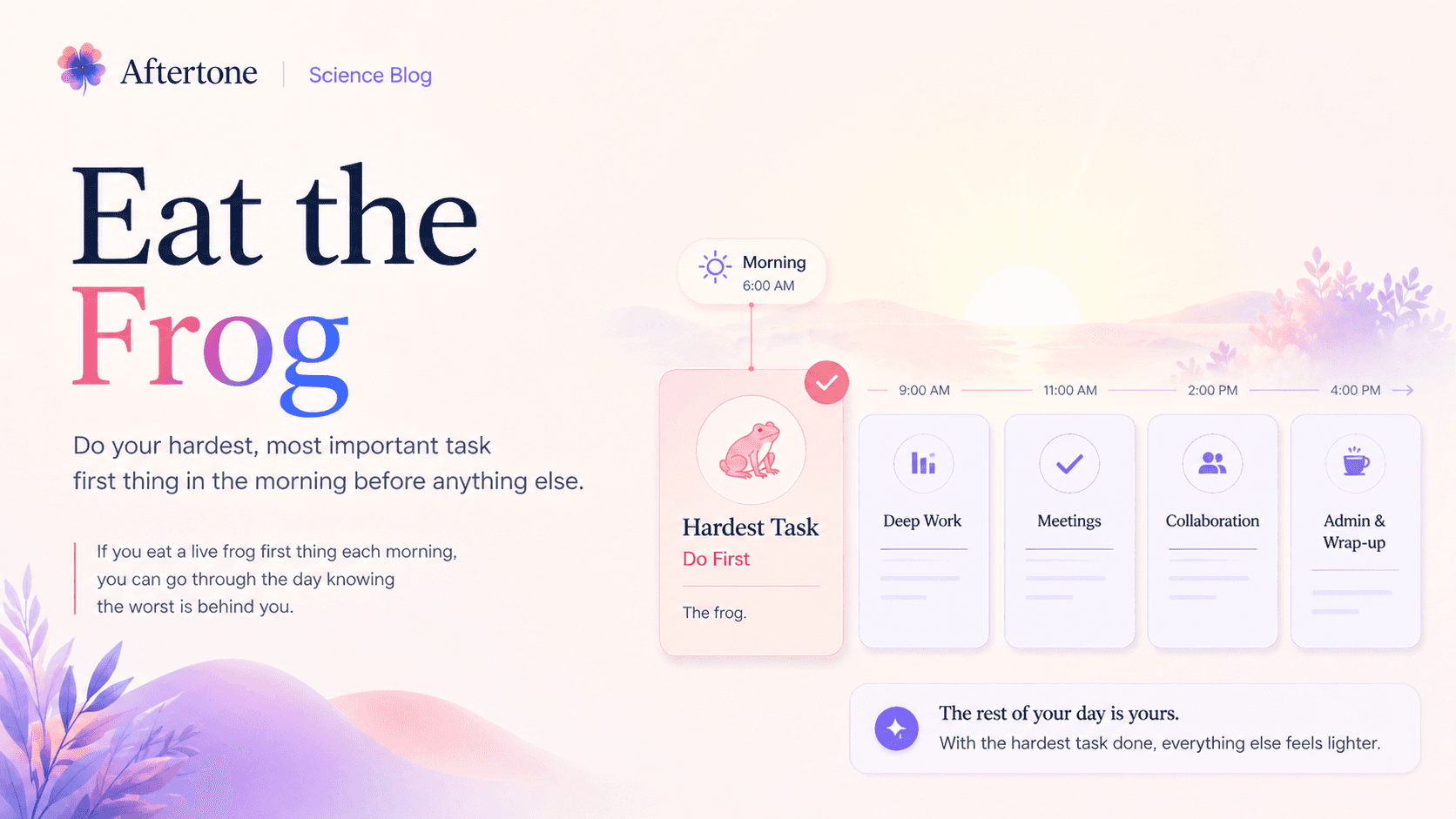
There is a task on your list right now that you have been putting off. Not because you do not know how to do it, and not because it is actually difficult in a technical sense, but because it requires effort of the kind that is easier to defer than to begin. You probably know exactly which one it is. Most people have a frog. Most people do not eat it first.
The advice to do so has been around in various forms for a long time. Mark Twain is often credited with the version that became most widely quoted: if you have to eat a live frog, it is best to do it first thing in the morning, and if you have to eat two, it is best to eat the bigger one first. Whether Twain actually said this is unclear. What is clear is that Brian Tracy built an entire book around the idea in 2001, and the phrase became one of the more durable shortcuts in productivity vocabulary.
What the metaphor actually means
The frog is not the hardest task on your list in a technical sense. It is the task with the highest resistance-to-value ratio: the thing that matters most and that you are most inclined to avoid. These two properties tend to cluster together for a reason. Tasks that require genuine creative or analytical effort, that expose your work to judgement, or that require confronting a difficult decision tend to generate avoidance behaviour in proportion to their importance. The larger the potential impact of a piece of work, the more the mind finds reasons to begin something smaller and more certain first.
The eat-the-frog principle is a forcing function against this tendency. By identifying the frog in advance and committing to it as the first work of the day, you remove the moment of decision at which the avoidance behaviour is most likely to operate. The decision has been made before the morning's competing demands have assembled.
The psychology: why mornings work for most people
Roy Baumeister's research on ego depletion, developed across multiple studies in the 1990s and 2000s, demonstrated that self-regulatory capacity, the ability to override impulse, persist through discomfort, and make difficult decisions, is a finite resource that depletes with use across the day. Subsequent research has complicated the picture somewhat, but the core finding is consistent with the everyday experience of most knowledge workers: decisions and effortful tasks that feel manageable in the morning become noticeably harder by mid-afternoon.
The practical implication is that morning is the period when the resistance to difficult work is lowest. The willpower required to begin the frog is most available before it has been depleted by the accumulated small decisions, social interactions, and cognitive demands of the working day. Beginning with the hardest thing takes advantage of this window rather than fighting the depletion that comes after it.
The morning also tends to offer the most uninterrupted time in most professional environments. Meetings accumulate across the day. Colleagues become active. Requests arrive. The pre-meeting morning window is often the only period where extended concentration is structurally possible without negotiating around other people's schedules.
When the method backfires
The eat-the-frog principle rests on two assumptions that are worth examining rather than taking for granted. The first is that morning is your peak cognitive period. For most people, particularly those with a morning or intermediate chronotype, this is accurate. For evening chronotypes, it is not. Forcing deep, demanding work at 7am for someone whose cognitive peak does not arrive until late morning or early afternoon means consistently scheduling the frog at the moment when the brain is least equipped to eat it. The principle is sound. The assumption that morning universally represents peak performance is not.
The second assumption is that you are correctly identifying your frog. The most common failure mode is confusing urgency with importance. The task that feels most pressing, the one generating the most external pressure, the one with the approaching deadline, is frequently not the most important one by the measure of long-term value. Eisenhower's distinction between urgent and important is directly relevant here: the real frog is usually a quadrant-two task, important but not urgent, which is exactly the category of work most vulnerable to being crowded out by the urgent and visible demands of the day. If you consistently find yourself eating frogs that turn out to be someone else's urgent priorities rather than your own important ones, the identification process needs examining.
There is also a subtler failure mode worth naming: using the eat-the-frog principle to justify avoiding everything that comes after the frog. The method is a prioritisation strategy for the beginning of the day, not a licence to spend the rest of the day on email after completing one meaningful task. The frog is the first thing. Other important things still exist.
Identifying the real frog
The most reliable question for identifying the genuine frog is not which task is most urgent or which has the most visible deadline. It is: which task, if completed today, would create the most meaningful forward momentum on something that actually matters? The answer is often a task with no immediate deadline, no external pressure, and no one waiting for it. These are precisely the tasks that most easily get pushed to tomorrow, and then the day after, and then the next week. The frog that has been living on the list for three weeks is almost certainly the real one.
Allen's next-action discipline from GTD is useful here. The frog is most effectively identified the evening before and written as a specific, concrete action rather than as a project label. "Work on the pitch deck" is not a frog. "Draft the problem slide with the three customer quotes from the June calls" is one. The specificity reduces the activation energy required to begin, which is most of what makes a frog hard to eat.
Implementation
The method has three practical requirements. The frog must be identified the evening before, so that the morning begins with a committed action rather than a fresh decision. It must be scheduled as the literal first calendar block of the working day, before email is opened, before messages are checked, before any other task is begun. And the environment at execution time must support concentration: notifications off, the relevant work open and ready, nothing else competing for attention.
The sequence matters. Opening email before the frog means starting the day in a reactive posture, processing other people's priorities before your own. The morning window that makes the frog eatable is exactly the window that a reactive email session consumes. Once it is gone, the frog goes back on the list for tomorrow.
Where Aftertone fits in
Aftertone's daily review surfaces the highest-priority tasks for the following day as part of the evening planning session. The frog identification happens there, at the end of the current day, so that the morning begins with the decision already made. The task is placed as the first block in the calendar. The Focus Screen removes competing demands when the block begins. The architecture matches the method: decide in the evening, execute in the morning, remove friction at the moment of starting.
The frog does not become easier if you leave it on the list. Every day it sits there, the psychological cost of its presence accumulates alongside the actual cost of the work it represents remaining undone. Eating it first is not a morning routine preference. It is the most direct available remedy for the specific kind of avoidance that prevents important work from happening.