Best Rise App Alternatives in 2026: Sleep Trackers and Energy-Aware Productivity Tools
Rise tracks sleep debt and circadian rhythm. The 8 best alternatives: Sleep Cycle, Oura Ring, AutoSleep, and Timeshifter for sleep — plus Aftertone.
Written By The Aftertone Team

Best Rise App Alternatives in 2026
Rise's premise is grounded in real science. Your cognitive performance follows a circadian rhythm — not just a generic energy wave, but a specific, predictable pattern that Satchin Panda's research at the Salk Institute has documented with precision. Peak alertness, post-lunch dip, second wind: these are physiological patterns that vary person to person but can be modelled from sleep data.
Rise applies that science usefully: it tracks your sleep, models your circadian rhythm, and tells you when you're likely to be sharp versus when you're not. The peak and dip windows appear alongside a sleep debt calculation. For users who've been vaguely aware they work better at certain times but never had data to confirm it, Rise is genuinely illuminating.
People search for Rise alternatives for two distinct reasons: they want a better sleep tracker (more accurate, different features, hardware-based), or they want the energy-aware scheduling intelligence to connect to their actual calendar and productivity tools. These are different needs requiring different alternatives. This guide covers both.
What Rise does well, and where it stops
The sleep tracking and energy modelling are Rise's genuine strengths. The model updates based on your actual sleep patterns, improving its predictions over time. The sleep debt concept translates physiological data into an actionable daily number. The design is clean and pleasant to use first thing in the morning.
The limitations are two: Rise doesn't measure sleep biometrics (it estimates from sleep duration data, not from sensors), and it doesn't connect to the tools you use to schedule your work. Rise tells you when you're biologically capable of high-output work. What it can't see is whether your calendar is actually creating the conditions for that work to happen.
Quick-pick: which alternative fits your situation
Want a smarter sleep tracker with a smart alarm: Sleep Cycle (free / $9.99/year)
Want biometric-grade energy tracking with a wearable: Oura Ring ($299+ hardware)
Want automatic Apple Watch sleep tracking: AutoSleep ($4.99 one-time)
Want jet lag and shift work circadian management: Timeshifter (free / $4.99/month)
Want to connect energy-aware scheduling to your calendar: Aftertone (Mac, $30/month) or Reclaim AI (Google Calendar, from $8/month)
Want full AI auto-scheduling of your tasks: Motion ($19/month)
At a glance: all alternatives compared
App | Price | Energy model | Sleep tracking | Calendar integration | Hardware needed |
|---|---|---|---|---|---|
Rise | $69.99/year (~$5.83/mo) | Circadian (sleep-based) | Estimated from sleep duration | Basic (calendar view) | No |
Sleep Cycle | Free / $9.99/year | Sleep stage trends | Smart alarm + stage tracking | No | No (uses phone mic) |
Oura Ring | $299+ hardware + $5.99/mo app | HRV-based readiness score | Medical-grade biometrics | Limited | Yes (ring) |
AutoSleep | $4.99 one-time | Apple Watch-based readiness | Automatic Apple Watch tracking | No | Apple Watch required |
Timeshifter | Free / $4.99/month | Circadian (jet lag focused) | No | No | No |
Aftertone | $30/month | Behavioural (calendar history) | No | Native (Google Calendar) | No |
Reclaim.ai | From $8/month | None (rule-based protection) | No | Google Calendar only | No |
Structured | Free / $29.99/year | None (visual planner) | No | Calendar sync (import) | No |
Motion | $19/month (annual) | Priority-based (implicit) | No | Full auto-scheduling | No |
Sleep tracker alternatives to Rise
1. Sleep Cycle — best smart alarm with sleep stage tracking
Best for: Rise users who primarily want smarter wake-up timing and long-term sleep trend analysis, rather than circadian rhythm modelling.
Sleep Cycle is the most widely used sleep app alternative to Rise and takes a different scientific approach. Where Rise focuses on sleep debt and circadian rhythm prediction from duration data, Sleep Cycle analyzes actual sleep stages using your phone's microphone and accelerometer, waking you during light sleep within a 30-minute window before your alarm time. Clinical research supports this: cognitive performance is measurably better after waking from light sleep than from forced awakening during deep sleep.
Sleep Cycle also provides long-term sleep trend analysis, sound recording to detect snoring, and a detailed sleep journal. The free tier is genuinely functional; Premium at $9.99/year adds detailed sleep analysis and trends. Many users run Sleep Cycle and Rise together — Sleep Cycle for the smart alarm and stage tracking, Rise for the circadian energy predictions.
Pros:
Smart alarm that wakes you during light sleep — the most immediately noticeable benefit
Actual sleep stage tracking (vs Rise's estimated approach from duration)
Free tier is genuinely useful — no hardware required
Sound recording identifies snoring and sleep disturbances
Available on iOS and Android — broader platform support than Rise
Cons:
Phone microphone tracking is less accurate than wearable sensors
No circadian rhythm modelling or sleep debt calculation like Rise
No calendar integration or productivity layer
Pricing: Free tier available. Premium $9.99/year.
Platforms: iOS, Android.
2. Oura Ring — best biometric-grade energy and readiness tracking
Best for: Rise users who want energy and readiness predictions grounded in actual measured biometrics rather than circadian modelling from sleep duration estimates.
The Oura Ring is the premium biometric alternative to Rise. Continuous heart rate, HRV (heart rate variability), skin temperature, and oxygen saturation give its Readiness Score and energy predictions a data foundation that phone-based apps like Rise cannot match. The Readiness Score synthesises sleep quality with recovery metrics to give a daily wellness assessment — similar to Rise's energy potential score, but based on actual measured physiology rather than predicted circadian patterns.
The hardware cost ($299–$499 for the ring) is the primary barrier. The companion app subscription at $5.99/month gives access to all sleep, activity, and health data. For users who want the most accurate consumer-grade energy data available, Oura is the answer — but it requires both the hardware investment and the ongoing subscription.
Pros:
Medical-grade sensors — HRV, skin temperature, oxygen saturation, continuous heart rate
Readiness Score based on actual biometrics, not circadian estimates
Integrates with Apple Health and other health apps
Also tracks activity, workouts, and overall health beyond sleep
Cons:
Significant hardware cost ($299–$499) plus $5.99/month app subscription
No calendar integration or productivity layer
More data, less actionable guidance — Rise is more prescriptive about what to do
Pricing: Ring $299–$499. App $5.99/month.
3. AutoSleep — best automatic Apple Watch sleep tracker
Best for: Apple Watch users who want automatic sleep tracking without wearing a dedicated sleep tracker or placing their phone next to the bed.
AutoSleep tracks sleep automatically via your Apple Watch while you sleep — no manual logging, no phone required. The app provides sleep quality scores, readiness metrics based on HRV, sleep stage breakdowns, and trends over time. At $4.99 as a one-time purchase (no subscription), it's the most affordable precise sleep tracker available for Apple Watch users.
The limitation relative to Rise: AutoSleep doesn't model your circadian rhythm or provide the circadian energy peak/dip predictions that Rise's core feature is built around. It tells you how you slept and gives a readiness score, but not when your energy will be high and low throughout the day.
Pros:
Automatic — works while you sleep, no setup per night
One-time $4.99 purchase — no subscription
Apple Watch sensor accuracy (HRV, heart rate) better than phone mic
Detailed sleep quality and readiness metrics
Cons:
Requires Apple Watch — not available without the hardware
No circadian rhythm modelling or daily energy peak/dip predictions
Apple ecosystem only
Pricing: $4.99 one-time (Mac App Store).
Platforms: iPhone, Apple Watch.
4. Timeshifter — best for circadian management around travel and shift work
Best for: Rise users who travel frequently across time zones or work irregular hours and need active circadian rhythm management, not just daily energy prediction.
Timeshifter is built for the specific circadian problem of jet lag and shift work. Where Rise models your daily energy cycle for a regular schedule, Timeshifter actively helps you shift your circadian rhythm: it generates a personalised plan for when to seek and avoid light, when to take melatonin, when to nap, and when to go to bed and wake up during and after travel — all timed to your specific flight schedule and destination time zone.
For frequent travellers, Timeshifter addresses a distinct and persistent Rise gap: Rise's circadian model assumes a regular schedule. If your schedule is constantly shifting across time zones, the model becomes less useful and Timeshifter becomes more so.
Pros:
Purpose-built for jet lag — the best tool available for frequent travellers
Personalised light, melatonin, and sleep timing plans for each trip
Free tier available for one trip
Cons:
Specialised — primarily useful for travel and shift work, not daily energy optimisation
$4.99/month — relatively expensive for occasional travellers
No calendar integration or daily productivity layer
Pricing: Free (one trip). $4.99/month or $24.99/year.
Platforms: iOS, Android.
Productivity tool alternatives to Rise
5. Aftertone — best for connecting energy-aware scheduling to actual calendar intelligence (Mac)
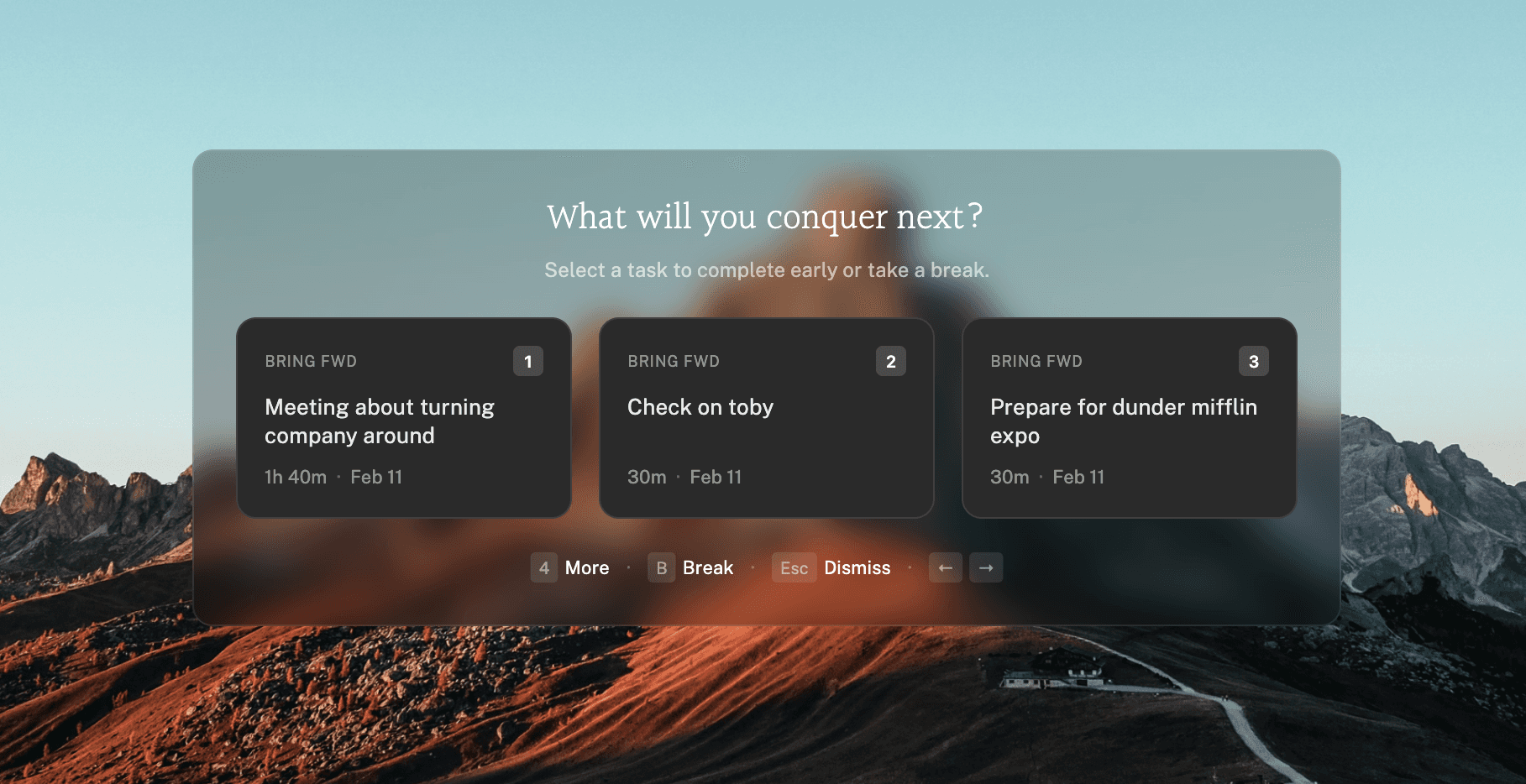
Best for: Mac users who want AI that learns their productivity patterns from actual calendar behaviour — energy-aware scheduling intelligence without a separate sleep tracking app.
Aftertone is a Mac-native calendar and task manager that addresses the gap Rise leaves on the calendar side. Rise tells you when your peak window is. Aftertone tells you whether your calendar is actually creating the conditions for that peak window to be used for meaningful work.
The distinction from Rise is the data source. Rise models your energy from sleep and circadian biology. Aftertone analyses your productivity patterns from your calendar behaviour — what you've actually scheduled, when you've historically done your best work, and what the resulting patterns reveal across weeks. The AI weekly and daily reports surface which time slots in your actual scheduled weeks tend to produce real output, whether your deep work blocks are placed in the right parts of your day, and how your current week's structure compares to your historically productive periods. This is a different kind of energy intelligence — empirical from your behaviour rather than predicted from your biology. Both answers different questions. Used together, they are complementary.
Pros:
AI weekly and daily reports — pattern analysis from actual calendar behaviour
Native calendar and task management in one Mac app
Focus Screen for single-task execution during work sessions
No wearable or sleep tracker required
Cons:
Mac only — no iOS, Android, or Windows
$30/month — significantly more expensive than Rise
Doesn't model circadian biology — behavioural intelligence only
Pricing: $30/month. 7-day free trial, no card required.
6. Reclaim.ai — best for automatically protecting energy peaks in Google Calendar
Best for: Google Calendar users who want to protect the peak windows Rise identifies — blocking them automatically before meetings fill them.
Reclaim.ai is the most practical bridge between Rise's energy prediction and calendar execution. Rise tells you when your peak window is. Reclaim can defend that time automatically — blocking it for focus work before meeting requests can fill it. The combination is effective: Rise identifies the optimal window, Reclaim defends it. Free tier available; Starter from $8/month. Google Calendar only.
Pros:
Automatically blocks focus time before meetings can fill it
Free tier available
Task scheduling from PM tools (Asana, ClickUp, Jira, Linear, Todoist)
Cons:
Google Calendar only
No analysis of whether protected time is being used effectively
Pricing: Free tier. Starter from $8/month.
7. Structured — best visual daily planner for translating energy windows into scheduled blocks (iOS)
Best for: Rise users who want a visual daily planner to make energy-aware time blocks concrete and visible on iPhone.
Structured provides the visual execution layer Rise lacks. Where Rise shows when to work, Structured shows what to work on in a visual time-block format. The combination — Rise for the timing recommendation, Structured for the execution interface — gives you both signals in adjacent apps. Structured doesn't replicate Rise's energy modelling; it provides the daily planning layer Rise doesn't have. Free tier; Pro $29.99/year or $64.99 lifetime.
Pricing: Free tier. Pro $29.99/year or $64.99 lifetime.
8. Motion — best for AI auto-scheduling that builds your day around your priorities
Best for: Rise users whose core problem is that they know when to work but can't consistently get the right work scheduled in those windows — and want AI to build the plan for them.
Motion is the full-automation alternative: it builds the entire daily schedule automatically from your tasks and meetings, prioritising by deadline and importance. The energy-awareness is implicit in the priority logic rather than explicit from biometrics. At $19/month annually it replaces the combination of a calendar tool and a task manager through automation. No analysis of whether the resulting patterns are working over time.
Pricing: $19/month individually (annual).
Using Rise and productivity tools together
Rise and the productivity tools above are not mutually exclusive. Rise reads your biology. Aftertone, Reclaim, or Motion act on your calendar. A productive combination: use Rise to identify your peak windows, then use Reclaim to block those windows before meetings can fill them, or Aftertone to understand whether those windows are actually being used for meaningful work in your historical schedule. The biological prediction and the structural reality are different data that answer different questions — both matter.
Frequently asked questions
What is the best Rise app alternative in 2026?
It depends on why you're looking. For a sleep tracking alternative with smart alarm: Sleep Cycle (free / $9.99/year). For biometric-grade energy tracking: Oura Ring ($299+ hardware). For automatic Apple Watch tracking: AutoSleep ($4.99 one-time). For connecting energy-aware scheduling to your calendar on Mac: Aftertone ($30/month). For automatically protecting focus time in Google Calendar: Reclaim.ai (free tier / from $8/month). For jet lag and shift work circadian management: Timeshifter (free / $4.99/month).
Is there a free Rise app alternative?
Yes. Sleep Cycle has a genuinely functional free tier covering smart alarm and basic sleep tracking. Reclaim.ai has a free tier that protects focus blocks in Google Calendar. AutoSleep is $4.99 one-time with no ongoing subscription. Structured has a free tier for visual daily planning. Timeshifter has a free tier for one trip.
Does Rise actually track sleep?
Rise calculates sleep debt and circadian rhythm from sleep duration data — it estimates rather than directly measures your sleep. It uses data from Apple Health or manual entry. It does not track sleep stages (light, deep, REM) or use biometric sensors. Users who want actual stage tracking should use Sleep Cycle (phone mic) or AutoSleep (Apple Watch sensors) alongside or instead of Rise.
Can I use Rise and a productivity tool together?
Yes — they address different problems and are genuinely complementary. Rise tells you when your biological energy is high. A productivity tool like Reclaim or Aftertone helps ensure your calendar actually protects that time for meaningful work. Rise handles the biology. The productivity tools handle the structure. The gap between knowing when to work and actually having that time protected in your calendar is where the productivity tools add value.
What is the difference between Rise and Oura Ring?
Rise models your circadian rhythm from sleep duration data using the SAFTE algorithm — no hardware required. Oura Ring measures actual biometrics continuously (HRV, heart rate, skin temperature, oxygen saturation) and generates a Readiness Score based on real physiological data. Oura is more accurate but requires a $299–$499 hardware investment plus $5.99/month. Rise is more accessible and more prescriptive about daily scheduling — it tells you specifically when your peaks and dips will be, whereas Oura gives you a readiness score to interpret. Many high-performance users run both.